
Bakersfield Directory Collections
The strongest Bakersfield city directory starting point is Beale Memorial Library's Local History Room. The library states that Bakersfield city directories date back to 1899, Kern County telephone directories date back to 1940, and donated school yearbooks are concentrated in the 1960s and 1970s. The holdings are room-use only and depend on staff availability. A call ahead can let staff confirm the target span and pre-pull microfilm or research material.
Other repositories fill specific gaps. The table separates a verified catalog or inventory from a promise of a complete run. Several sources are discovery aids, so confirm access before travel.
| Collection | Years verified | Where held | Access |
|---|---|---|---|
| Bakersfield city directories | Dating back to 1899 | Beale Memorial Library Local History Room | Room use; call 661-868-0771 |
| Kern County telephone directories | Dating back to 1940 | Beale Memorial Library | Room use; staff availability |
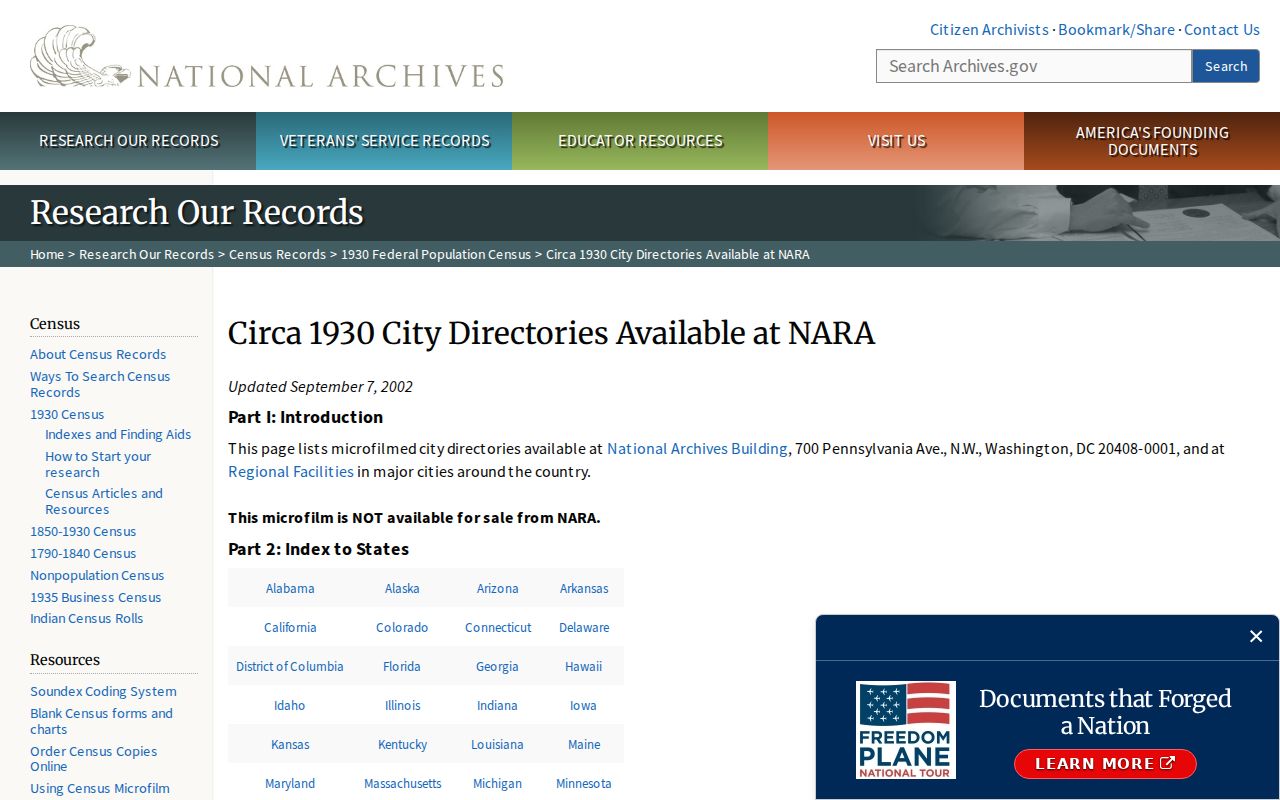
| National Archives city directories | 1927-1932 | NARA reference list | Catalog and repository route |
| Newberry city directories | 1922 and 1924 | Newberry Library catalog | Verify repository access |
| FamilySearch Bakersfield volume | 1962 | FamilySearch Library catalog | Catalog and library access |
| Additional genealogy inventory | 1906-1908, 1910-1935, later scattered years | Allen County and subscription collections listed by guide | Discovery aid; confirm holdings |
The year ranges do not establish the first publication year, the last printed year, or every missing edition. They identify routes that a historical researcher can test.
Beale Library's Bakersfield Directory Shelf
Beale Memorial Library is at 701 Truxtun Avenue, on the second floor of the main library building. The Local History Room telephone is 661-868-0771. Staff ask researchers to call before visiting because access depends on availability, even though other library resource pages show regular public hours. Materials cannot be checked out. A remote researcher can use the library's obituary or article and research request routes, and headquarters can be reached at 661-868-0700 or info@kernlibrary.org.
The room's value goes beyond a single city directory. It holds books, pamphlets, periodicals, newsletters, vault material, and vertical files on more than 900 subjects, with some primary sources reaching into the 1800s. Digitized Bakersfield Californian issues cover 1875-1977, later microfilm runs from 1978 to the present, and other Kern County newspapers fill local gaps. An obituary, legal notice, marriage item, or business advertisement can explain why a household moved between two directory years.
Ask for a surname and address together. Staff can check whether the requested city directory, telephone book, microfilm reel, yearbook, or newspaper is present, rather than treating a general catalog description as proof that every edition is on the shelf. The room is the practical fallback when a directory is not scanned or indexed online.
National Bakersfield Directory Holdings
The National Archives city-directory list places Bakersfield volumes in the 1927-1932 period, a useful bridge around the 1930 census. The Newberry catalog identifies 1922 and 1924. FamilySearch catalogs a 1962 volume titled Bakersfield, including Oildale, with a buyers' guide and classified business directory.
The captured NARA view is a finding aid, not a scanned page. It tells a researcher which years were reported to the federal reference list and where to pursue the material.
The FamilySearch catalog is similarly a repository record. The entry's location and call number should be checked before a trip or interlibrary request.
An established genealogy inventory lists further years at Allen County Public Library and in subscription collections. It is a useful map of possible coverage, not an authoritative shelf guarantee. The Kern County Historical Society is another contact route, although no searchable directory-holdings catalog was verified there; its published contact email is info@kernhistoricalsociety.org.
The published Kern County year inventory is a discovery aid for scattered years and repositories.
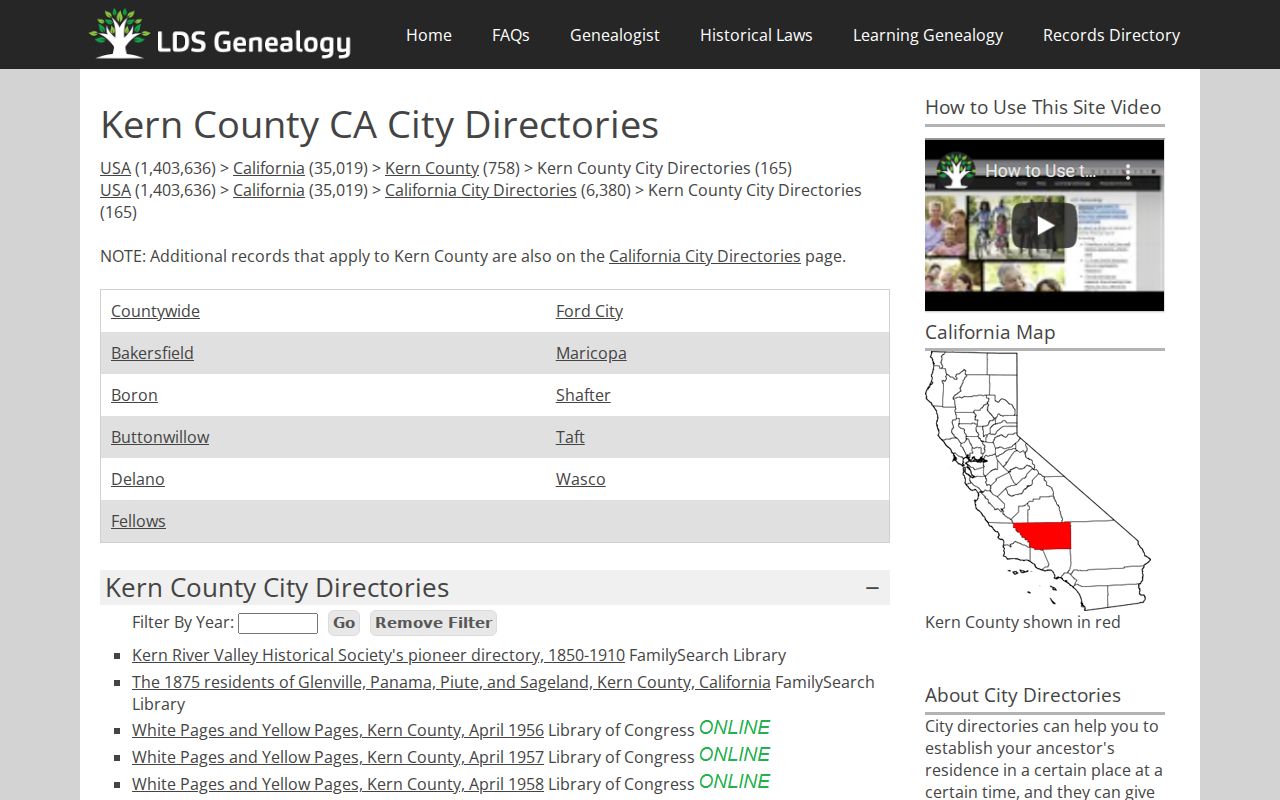
Use the inventory to choose a follow-up call or catalog search, then confirm that the stated volume can actually be consulted.
Reading a Bakersfield Directory Entry
A Bakersfield city directory entry should be treated as a dated observation. The research sweep did not capture a verified Bakersfield page image or a complete local abbreviation key, so exact symbols should not be invented. When a volume is open, transcribe the entry exactly, record its section, and photograph or cite the page under the repository's rules.
The following inventory is a safe worksheet based on the library's stated holdings and the documented tracing method. It tells what to look for without claiming that every year uses the same layout.
| Inventory item | What to record |
|---|---|
| Name | Exact spelling, initials, suffix, compound surname, and any cross-reference. |
| Address | House number, street spelling, unit or apartment notation, and the directory section. |
| Occupation | Printed occupation and employer wording when shown. Do not silently modernize the entry. |
| Family clue | Spouse, widow notation, household relationship, or another phrase printed with the name. |
| Abbreviation | Exact mark or short form, with its meaning taken from that volume's key rather than guessed. |
- Criss-cross directory
- An address-first section that reverses the usual name-to-address order. Confirm that the target year actually includes one.
- Householder index
- A name or household listing that can lead to an address. It may not include every person in the home.
- Abbreviation key
- The volume's own explanation of short forms. One publisher's mark should not be applied to another year.
A name, address, and occupation together make a stronger historical clue than any one field. The entry still needs a second source before it is treated as a settled identity.
Tracing Bakersfield Directory Households
To follow a Bakersfield household across time, use the directory as a sequence rather than a single answer. Pair the edition with the nearest federal census, then test changes against a deed, newspaper, Sanborn map, or vital record. Census schedules are available through 1950 under the federal 72-year release rule, so earlier directories can supply address clues that point toward the correct household.
- Write down the surname, given name, occupation, spouse or family clue, address, edition year, repository, and page.
- Check the next available directory year. Treat a new street number as a question, not proof of a move.
- Compare the address with the closest census household, including spelling, age, occupation, and household members.
- Use a newspaper notice, obituary, deed, permit, or Sanborn sheet to explain an address or building change.
- Repeat the match across two or more years and preserve gaps rather than filling them with an assumption.
A telephone directory after 1940 may add a phone and address, while a yearbook can identify a younger person who is absent from an adult household listing. Those sources complement the city directory but do not turn into a complete current residents directory.
Bakersfield Sanborn Address Records
Library of Congress Sanborn sets give Bakersfield building snapshots for 1885, 1888, March 1889, January 1890, July 1892, July 1899, March 1905, 1912, 1949, and 1951. A separate January 1890 East Bakersfield set matters when an eastern address appears to vanish from a general Bakersfield search. Maps show street names and numbers, building footprints, materials, uses, and block context.
Use a Sanborn sheet when a directory address changes spelling, a building is rebuilt, or the East Bakersfield and Kern City context is unclear. The Library of Congress 1890 Bakersfield Sanborn item is one verified entry point. The map dates the structure and street setting, not the name of an occupant. Pair it with a directory entry, deed, newspaper, or census line.
Sanborn evidence is especially useful around Bakersfield's 1889 fire, the 1898 Kern City and East Bakersfield fire, and the 1952 earthquake and demolition cycle. Those events explain changes in the built record. They do not prove that county record books were lost.
Bakersfield Directory Clues in Newspapers
The Bakersfield Californian is the local bridge between directory editions. Digitized issues from 1875-1977 and microfilm from 1978 to the present can supply obituaries, marriage notices, legal notices, business advertisements, school items, and arrival or departure clues. The library also reports Shafter and other surrounding-community newspapers, which can help when an address lies outside the simple Bakersfield city frame.
Yearbooks are strongest for classmates and school communities, especially the donated elementary, junior-high, high-school, and college volumes concentrated in the 1960s and 1970s. Record the school, year, printed name, organization or image caption, and any address clue. A yearbook identifies a school connection, not a complete household or current residence.
The library's online local-history resources also point to Flickr, the Online Archive of California, SJVLS Digital Collections, the Clyde Johnson Photography collection, the Curtis Darling Postcard Collection, and Calisphere. Photographs can corroborate a streetscape, business, church, or neighborhood while leaving the person match open for a separate source.
Bakersfield Directory Context
Historical directory research should use more than the modern city label. Bakersfield began around Kern Island, incorporated in 1873, and became the Kern County seat in 1874. Southern Pacific arrived in 1874, Santa Fe in 1898, and recoverable Kern River oil appeared in 1899. Rail, farm, and oil growth changed the occupations and business names printed in successive city directories.
The separate 1890 East Bakersfield Sanborn volume is a useful geographic warning. An older entry may use East Bakersfield or Kern City language even when a modern searcher expects only Bakersfield. Compare the address, street, map, and directory publisher before treating different labels as different households.
A City historical report cites Polk-Husted Directory Company material around the 1928 and 1930 period. That supports a publisher clue for those editions, but it does not establish every Bakersfield city directory publisher or a complete publication run.
Bakersfield Directory Gaps and Calls
The verified sources leave some questions open. Beale Library does not publish an edition-by-edition list, the full reverse-directory run, a publisher chronology, or the last printed Bakersfield volume. The research sweep did not capture an approved online sample page, so local abbreviations and visible marks require an in-room or repository inspection. A genealogy inventory may list years that are difficult to access or scattered among institutions.
That is a reason to use the fallback chain, not to fill a missing year with a guess. Call Beale Library first. Check NARA, Newberry, FamilySearch, and the Allen County inventory. Ask the Kern County Historical Society whether a particular name or year is within its programs. Search newspapers and Sanborn maps around a gap. Then verify any present-day address or person through the appropriate county custodian.
A city directory is most valuable when its limits are written beside its clues. Record the volume, publisher if printed, edition year, page, repository, exact wording, and the next source used to test it.