
Bakersfield Previous Resident Sources
Previous residents appear in layers. Recorded instruments show legal parties and transfer sequence. City directories and telephone books show listed households in an edition year. The federal census can pair names, ages, occupations, and household structure through 1950. Sanborn maps show the building and street context. Permits date physical work, while probate and obituaries can explain a transfer endpoint or family link.
| Source | Years it covers | Where held | What it shows |
|---|---|---|---|
| Kern Recorder online index | Start year unpublished | Online name, number, date, class paths | Parties, roles, dates, instrument number |
| Recorder counter and kiosks | Historical cutoff unverified | Hall of Records and Recorder Annex | In-person APN and older index access |
| Beale city directories | Dating back to 1899 | Local History Room | Address and listed household by edition |
| Kern telephone directories | Dating back to 1940 | Beale Memorial Library | Telephone and address clues |
| Federal census | Decennial through 1950 | Federal and library access routes | Household, age, occupation, and tenure |
| Sanborn maps | 1885-1951, with East Bakersfield 1890 | Library of Congress | Building, street, use, and block changes |
| Permits and probate | Current or file-specific coverage | Bakersfield and Kern Superior Court | Physical work, succession, heirs, and notices |
The absence of a published Recorder start year is itself a research note. Do not turn an unknown cutoff into a made-up coverage date.
Start With a Bakersfield Parcel
A modern address is the entry point, but the APN, ATN, legal description, and map link make the better anchor. Search the Kern Assessor by address, save the parcel key and situs, and compare the result with Bakersfield or Kern GIS. Owner names are suppressed from the web card, so the card does not finish the current-person question. It gives the land identity that lets a lawful deed or counter search begin.
Check the city address point's OLD_ADDRESS, mailing-address flag, street components, unit, and source fields. Confirm that the point is a deliverable address rather than a meter or cartographic feature. If the address has changed, preserve both the current spelling and historical line. A legal description that names a block, lot, tract, phase, or Sales Map Lands can bridge a street rename or APN change.
Modern parcel geometry can shift. New tracts may carry NEW before an APN is assigned, and some common areas use CONDOLOT. These labels are clues for the parcel trail, not names of previous residents.
Bakersfield Grantor-Grantee Trail
The Kern Recorder index is the central backward path. Find a known current grantee, read the acquisition document, then move the predecessor grantor into the grantee search for an earlier period. Repeat until the index or in-person source ends. Search both roles, legal names, spouses, trusts, entities, successor trustees, initials without periods, and spelling variants.
- Search the current or known party in the Kern grantor-grantee index with a likely date range.
- Save document number, recording date, class, every indexed party, book or page, and the legal-description clue.
- Order or inspect the image. Record vesting, legal description, return address, related instruments, and transfer references.
- Search the predecessor as a grantee before the current transfer date, then repeat the role switch.
- Resolve same-name parcels with map, lot, block, tract, phase, APN, and instrument context.
The index has name, document number, date, and class modes. Important classes include deed, quitclaim deed, deed of trust, reconveyance, lien, map, marriage, certificate of death, annexation, subdivision, and notice of default.
The captured Kern grantor search shows the name-based starting path.
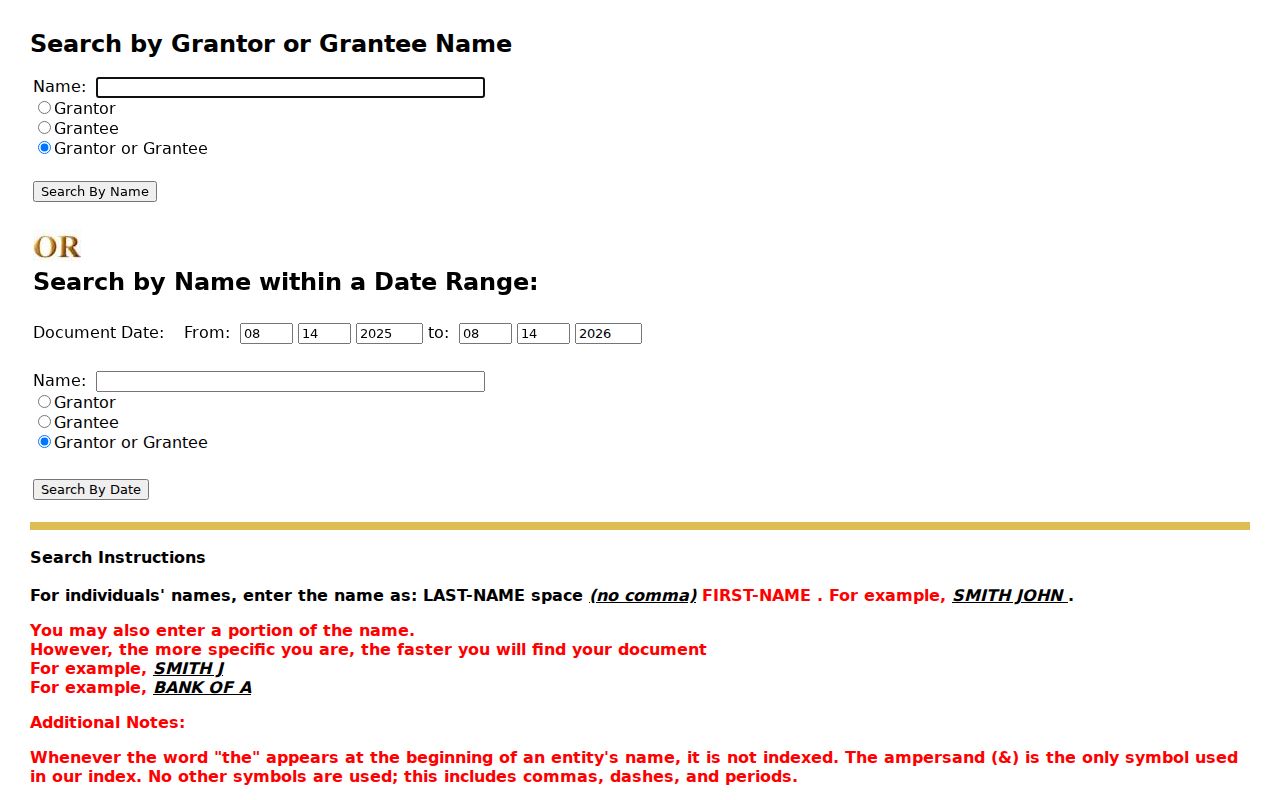
The result is a party index. The recorded image and legal description are the next evidence step.
Bakersfield Deed Index Limits
Kern removed APN searching from the online Official Record Search effective December 9, 2024, but APN searching remains available at Hall of Records and Recorder Annex kiosks. The county has not published the exact first year or historical cutoff for its online name index. When a web result ends, the practical fallback is an in-person grantor-grantee search, a kiosk lookup, or a written copy request using the strongest known document details.
Recorded copies are ordered only in person or by mail, not by phone, fax, email, or online. A mail request needs an instrument number, book and page if present, recording year, at least one party, document type, return name and address, and page count. Mail goes to Hall of Records, 1655 Chester Avenue, Bakersfield, CA 93301, with a check or money order and a self-addressed stamped envelope. The county retains the search fee when no record is found.
The captured Kern document-number search shows the alternate route when an instrument number is known.
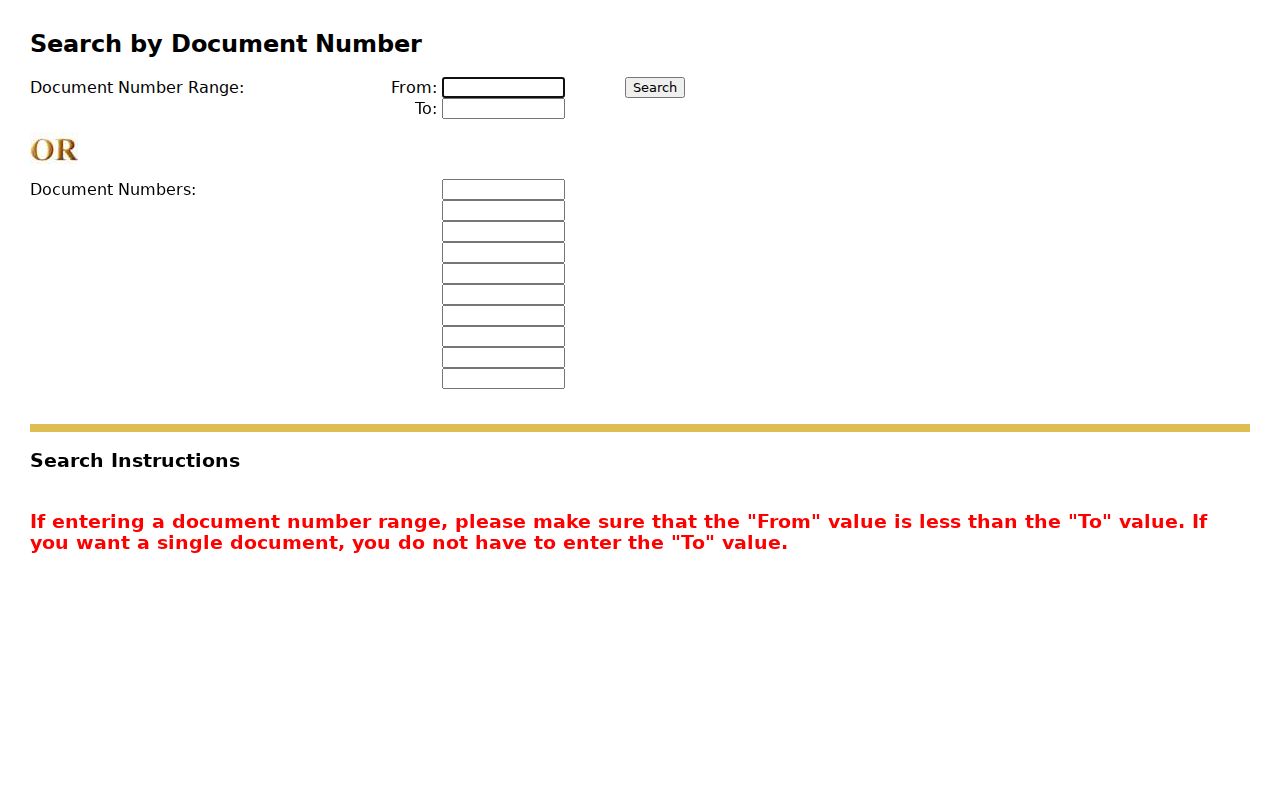
A missing online result is a prompt to change access channel, not proof that no earlier instrument exists.
Old Bakersfield Addresses in GIS
Bakersfield's GIS address layer includes OLD_ADDRESS, current street components, unit fields, ZIP, and IS_MAILING_ADDRESS. Planning's master street file and the 2005 Addressing and Street Naming Program add a written route for names that were consolidated or changed. The program weighs historical significance, the segment with the fewest address changes, the oldest name, neighborhood fit, and recognized use.
Early Bakersfield used numbered downtown blocks and lots, sometimes lettered blocks, while named additions such as Lowell Addition and rural Sales Map Lands used their own legal-description patterns. A current APN search may not reproduce that historical wording. Compare block, lot, map, phase, and parcel references before concluding that an old household left town.
OLD_ADDRESS is a bridge, not a final identity. Confirm the bridge with a map, deed, directory, or newspaper.
Bakersfield Directories and Previous Residents
The Bakersfield city directory collections supply the household layer between federal census releases. Beale Library reports city directories dating back to 1899 and telephone directories dating back to 1940. NARA lists Bakersfield volumes for 1927-1932, Newberry lists 1922 and 1924, and FamilySearch catalogs a 1962 volume including Oildale.
For each edition, copy the exact name, address, occupation, spouse or family clue, publisher if printed, page, and repository. Compare the next available year. A changed number can reflect a move, renumbering, or a rebuilt block. Pair the directory with the nearest census, a newspaper item, a deed, or a Sanborn sheet. Telephone books can add a later address clue, while a yearbook may identify a younger household member.
- Place the directory edition on a timeline with the nearest census year.
- Match surname, given name, age, occupation, and household clues across the two sources.
- Use street spelling, block context, and legal description to test an apparent move.
- Mark an unverified gap rather than inventing a missing directory year.
Beale asks researchers to call 661-868-0771 before visiting because access depends on staff availability and material is room-use only.
Bakersfield Sanborn Records
Library of Congress Sanborn maps capture Bakersfield in 1885, 1888, March 1889, January 1890, July 1892, July 1899, March 1905, 1912, 1949, and 1951. East Bakersfield has a separate January 1890 set. The maps show street numbers, building footprints, construction material, uses, and block context. They are often the missing bridge between a directory address and a modern parcel.
Use the maps to date a structure, separate two similar addresses, or see whether a block changed after the 1889 Bakersfield fire, 1898 Kern City fire, or 1952 earthquake. The map does not identify every occupant. A building that survives while a name changes, or a new building at the same lot, should be documented as two different evidence points.
Search both Bakersfield and East Bakersfield or Kern City labels around 1890. The separate volume is a local geography clue and can prevent a false gap in a previous residents search.
Bakersfield Permit and Probate Records
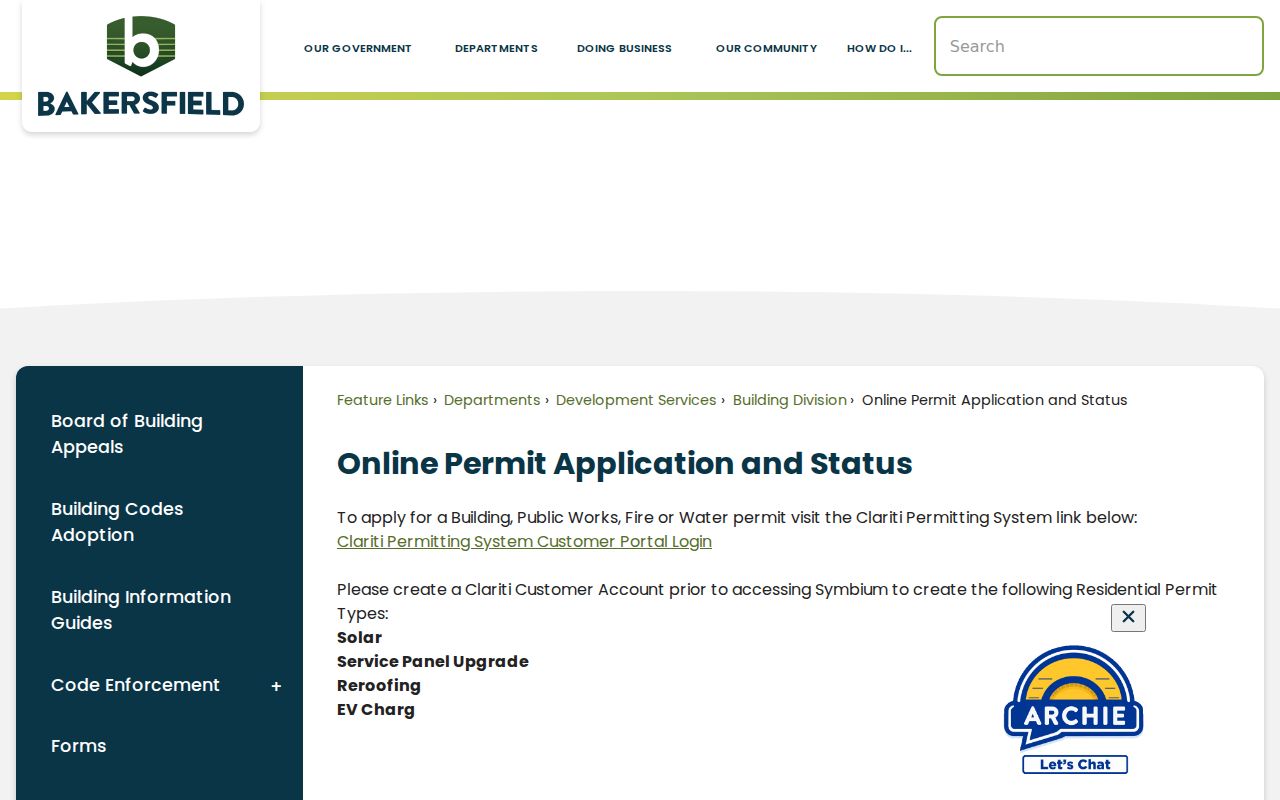
Bakersfield Development Services permit files can date construction, additions, demolition, unit changes, and use. The online e-Permit or ProjectDox route requires a login and covers selected permit types. A permit's person may be an applicant, contractor, architect, engineer, owner, or business, so the role must be copied with the name. Request older address or code files through the city records gateway when the live portal does not expose the history.
The city permit status route is represented by the captured screen below.
Probate is a different trail. Kern Superior Court probate files can explain a decedent, petition, heirs, notice addresses, and succession. The probate division's access routes should be checked before a visit.
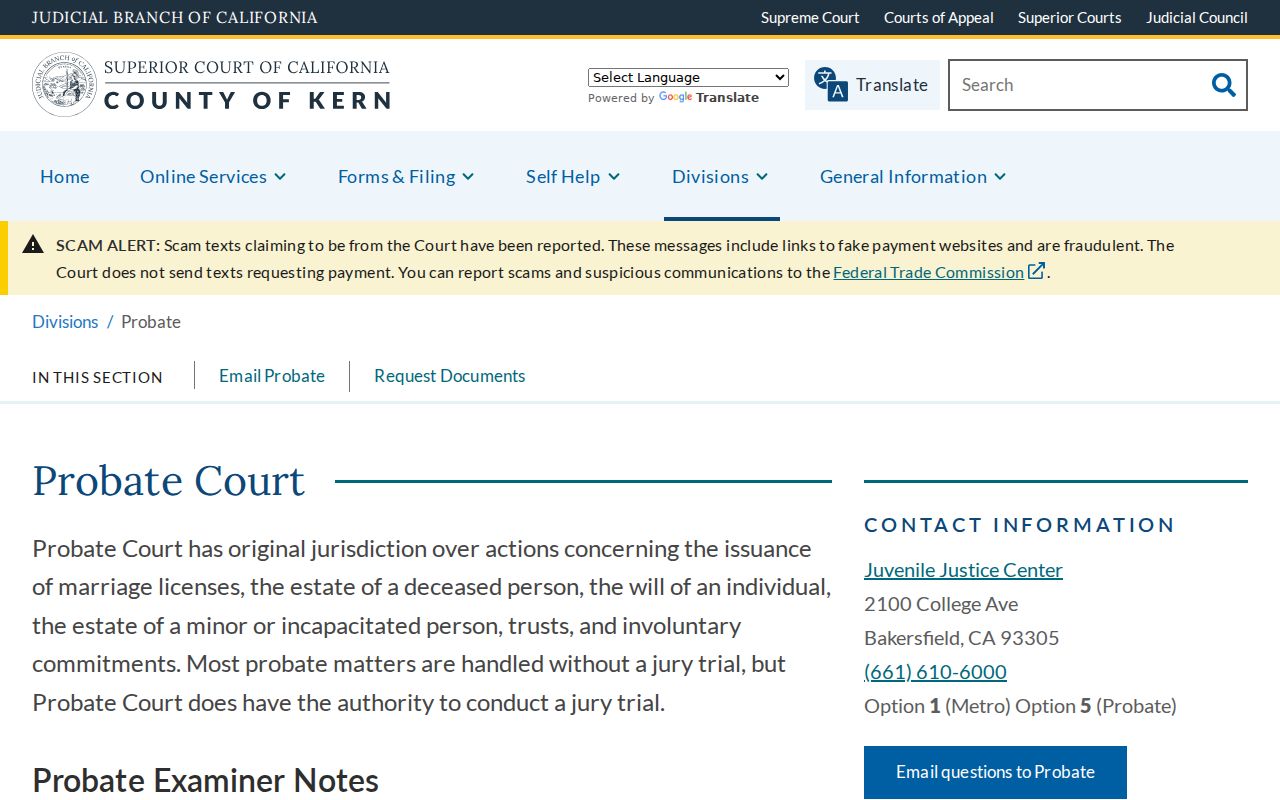
A permit can explain a building change, and probate can explain a chain endpoint. Neither one alone proves who occupied the address.
Bakersfield Legal Description Records
A chain of title is the ordered sequence of recorded interests in one parcel. The legal description is the land language that connects each instrument. In Bakersfield it may use a tract, phase, lot, block, map number, aliquot, metes and bounds, or older Sales Map Lands. A street name can change while that legal description remains recognizable.
- Grantor
- The party conveying or transferring an interest in a recorded instrument.
- Grantee
- The party receiving the interest. In a backward chain, the current owner is often the first grantee to test.
- Chain of title
- The sequence of recorded transfers and related instruments used to trace an interest through time.
- Legal description
- The map, lot, block, tract, phase, or boundary language that identifies land beyond a mailing address.
Retain the original spelling and punctuation of a historical description. Then compare it with the current GIS parcel and map layers. A modern APN is a useful index key, but the old legal description explains why a present-day search may not match the past wording.
Bakersfield Previous Resident Limits
Previous residents research is strongest when it describes a house, parcel, and dated record trail rather than trying to fill every private gap. Deeds and probate can identify legal parties. Directories and census schedules can describe listed households. Newspapers can explain a death, move, marriage, or business. A current household member who never appeared in one of those sources remains outside the evidence.
House-history use. A Bakersfield address trail can support genealogy, preservation, ownership research, and family reconnection. Do not use past-resident records to stalk, harass, threaten, or harm any person, and do not treat a public address clue as permission to pursue a protected household.
When a former household name becomes the focus, use the separate resident lookup rules for spelling and independent matches. When the question expands to every parcel on a current street, use the Bakersfield street directory and its present-day address chain.